The Problem
Wearing my AV system designer hat, I often juggled disconnected tools for calibration, analysis, and asset generation during project planning and testing. Calculating pixel densities, generating test patterns, and verifying signal flows required switching between multiple single-purpose apps, copying and pasting assets and values to build comprehensive planning packages for creative content development, pre-visualization, and system design. This inefficiency sunk significant time into the administration of workflows, a pain point I’ve seen echoed in teams I’ve managed where fragmented tools hindered technical deliverables.
Over the past 3 years (since early 2023) agentic AI engineering has enabled me to prototyped and developed systems and tools using platforms like Claude Code and Cursor in a way that was not previously possible. Drawing on this, I set out to develop a unified platform that transforms siloed tools into outcome-focused workflow, directly addressing enterprise needs.
My Solution
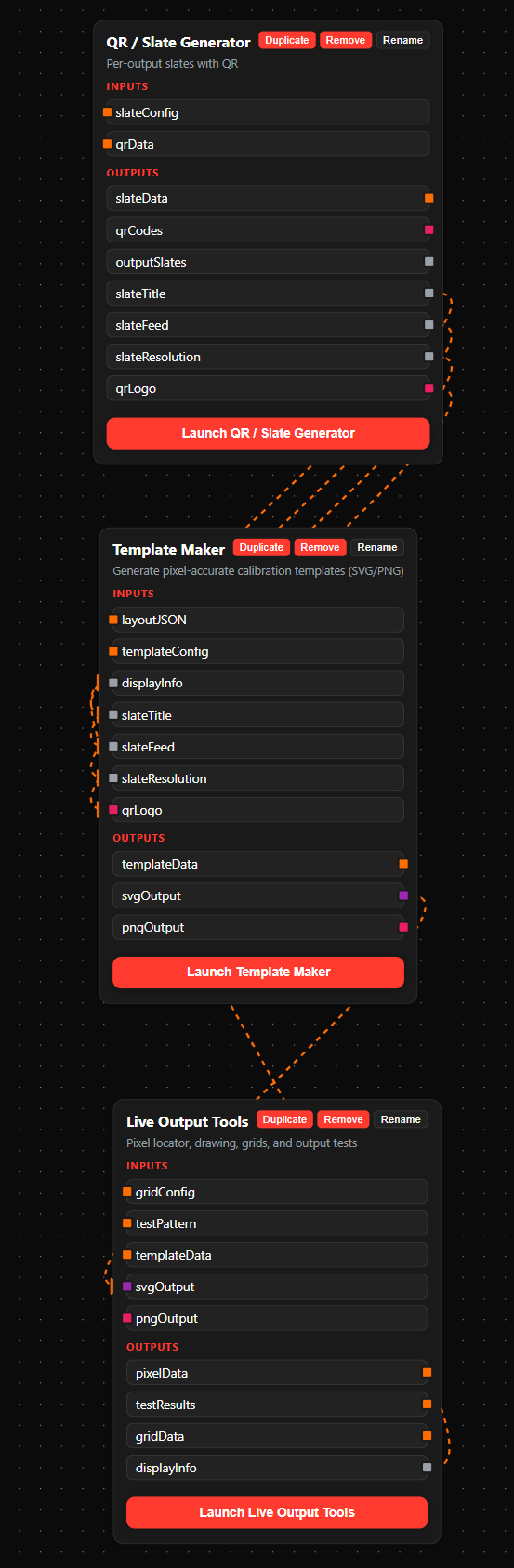
‘OpKit Patchbay’ is a node based workflow toolkit for the web. Built on ‘React Flow’, it allows users to chain together functional nodes; Generators, Analysers, and Calibration tools into custom savable and sharable workflows.
Key Features
● Node-Based Workflow: Drag-and-drop interface to connect tools dynamically.
● Signal Generation: Create custom QR slates, projection grids, and calibration templates.
● Professional Analysis: Tools for pixel density (PPI/Pitch), viewing distance calculations, and blend region visualization.
● Live Output: Real-time rendering of test patterns and templates for on-site system verification and real-world feature identification using the systems video outputs.
At the time of writing this it’s currently in BETA, with an aim to develop further over time and productise workflow and creation for immersive productions.
Its free to use and available to experiment with from here: Launch OpKit Patchbay
Best,
Simon Graham